Product line · 01Process & Control Engineering
Process & Control Engineering
Software for the work that ends in a drawing, a program or a plant model — and for the studies behind the decision.
Free during launch Free builds from this site while the launch period runs. Paid editions and an App Store listing come later; nothing here requires an account or a key.
The line exists because a control engineer's real output is not a diagram on a screen — it is a numbered drawing set, a program that runs on the plant's PLC, and a model somebody can check. Each tool below stops at a specific point in that chain.
- Products
- 4 released
- Services
- Digital twin · custom
- Source
- Open core · paid editions later
- Runs
- Offline, no account
- Buyer
- Plant engineering groups
01Products
Four tools, four points in the chain
02Valve OTS
Sizing a valve by simulating the plant 2.6 / OTS 0.5.0
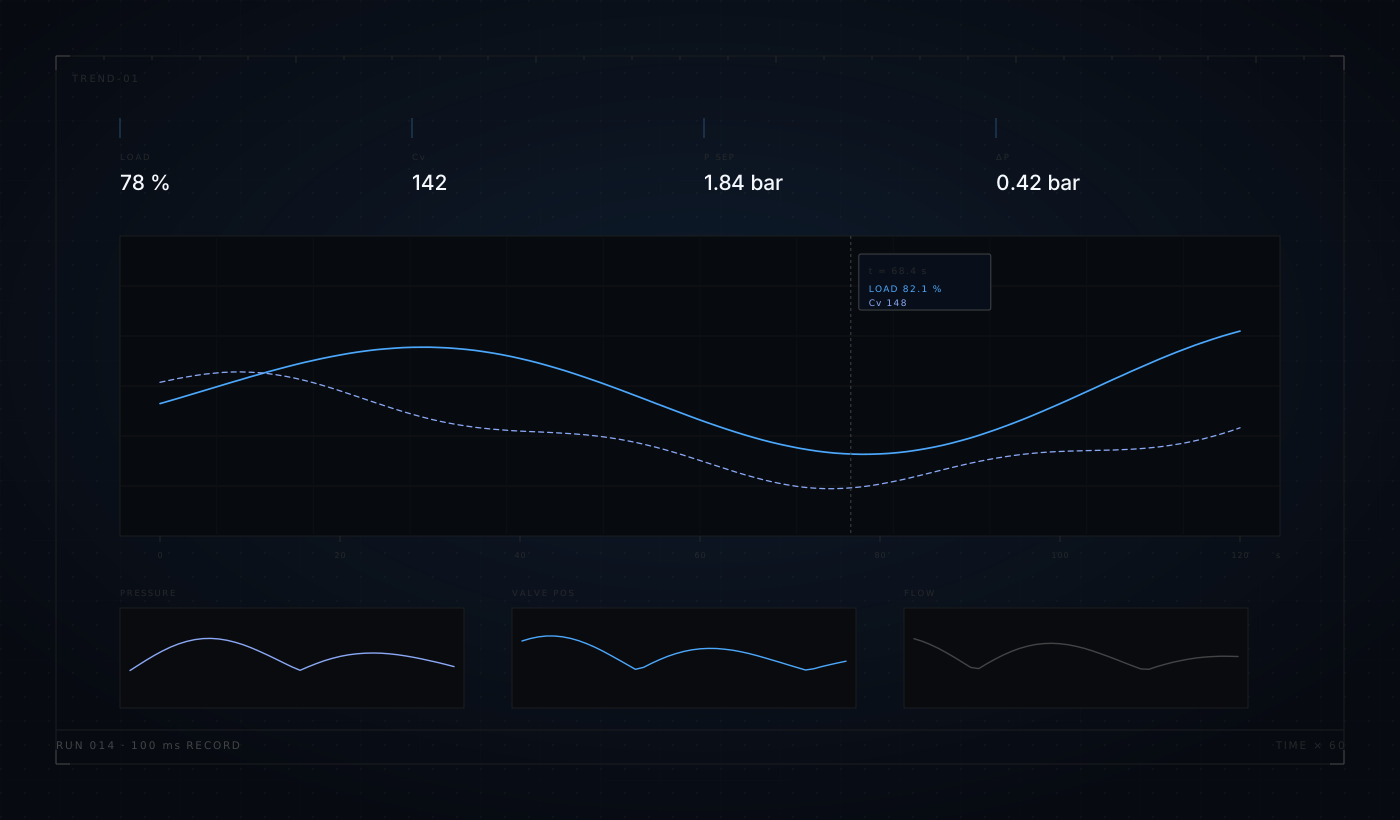
With N electrolysers feeding one separation system, the concrete question is: what Cv do the outlet valves need, and how does the control strategy behave when load moves? Valve OTS answers it with a dynamic model rather than a spreadsheet.
It models separator volume from the cylinder geometry, the liquid mass balance, O₂ vented through a flame arrestor, H₂ to purification, and split-range or small-valve position control with one or two valves per side.
4 × 1000 Nm³/h
Reference case, plus a 4000 Nm³/h separation system
100 ms
Control and record cycle in the OTS engine
1× – 60×
Time acceleration
Scenario · operator
Two ways to use the same model
- Scenario check: load steps, pulses, ramps, start/stop, wide load swing, pressure step, downstream disturbance, H₂ routing switch — compare Cv options, then replay on the operator console.
- Operator mode: drive load setpoints live, change PID parameters, switch to manual.
- Every run archived to its own folder: 100 ms CSV, parameter snapshot, event log and summary, with history replay on a time slider.
Documentation and interface for Valve OTS are Chinese-first, because the buyer for this kind of study usually is too. The reference case and the model are the same in either language.
03Services
When a product is not the answer
Two kinds of engineering work sit alongside the products. Both start with a scoped question, not a licence.
Digital twin
We build virtual plants your controllers can be tested against: a reduced-order model of a multi-stack alkaline electrolyser, its gas-liquid separation, lye circulation and heat exchange. Every actuator and instrument is exposed through an OPC UA server — manipulated variables writable, process variables readable, disturbances injectable — running 1:1 against wall clock.
The purpose is controller development and closed-loop debugging before the plant moves: large power steps, cooling failure, low load, hot standby.
Purpose-built tooling
Some workflows are specific enough that no product will fit: one plant, one report, one piece of equipment. If it can be described precisely, it can usually be built — by the same person who wrote the products, with a short path from problem statement to a working tool.
That work is quoted per project. It is deliberately not productised, because the point is the fit.
04Next
Bring us the drawing you have to hand over.
Tell us what the deliverable looks like and what the plant runs on. If a product fits, we will say so; if the answer is a study, we will scope that instead.